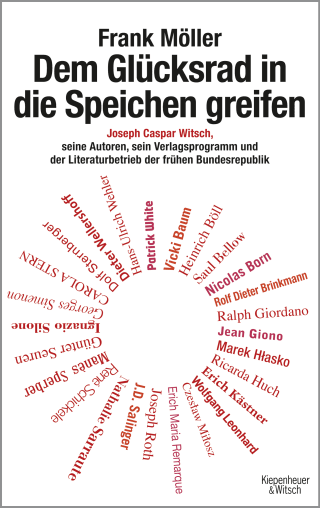
With charisma and entrepreneurial flair, company founder Joseph Caspar Witsch brought together many distinguished pre and post-war German writers under the one roof of Kiepenheuer & Witsch immediately after the publishing house’s foundation. Following on from his first biographical study (Das Buch Witsch), Frank Möller now presents a fascinating close-up view of many of these authors and their work and of the relationship Witsch maintained with them, and he also offers a look behind the scenes of the literature business between 1949 and 1947.
Kiepenheuer & Witsch published over 600 books in the 18 years under Witsch’s direction – a remarkably broad and innovative spectrum of fiction, non-fiction and specialist books. Very early on, Witsch succeeded in signing up eminent exiled writers, including Joseph Roth, René Schickele and Erich Maria Remarque, offering readers access to the long-awaited foreign language works of Saul Bellow, J.D. Salinger, Georges Simenon, etc. Witsch also focused on young German writers, from Heinrich Böll and Rolf Dieter Brinkmann to Nicolas Born – stubbornly avoiding all contact to the literary association Gruppe 47. With social and political books by Wolfgang Leonhard, Ralph Giordano or Hans-Ulrich Wehler, Witsch also had a major impact on public opinion-making.
A successful entrepreneur, Witsch was alert to changes in the book market and launched initiatives with other publishing companies, the foundation of dtv being just one of them. Grabbing the Fortune Wheel by the Spokes is therefore not just a colourful portrait of the early days of Kiepenheuer & Witsch, it is also a fascinating journey in time through the history of publishing, culture and society in the young Federal Republic of Germany.